
 Back to articles
 David Zelenka

You can build a marketing strategy in 5 steps: goals, target audience, positioning, a plan for each stage of the buying journey, and measurement. I'll show you what to prepare first, how to work through each step, and where to start when you don't have time for everything.
Most businesses don't lack a strategy because they don't want one. They lack one because they don't know where to start. Someone writes down a list of channels, a budget, and a posting calendar – and that gets called a strategy. In an earlier article, I explained why tactics without a strategy don't work. This is the practical part: a process you can use to put together a basic strategy yourself, without unnecessary theory.
If you first need to know what a marketing strategy is and what it isn't, see what a marketing strategy is. This article is about how to create one.
What to prepare before you start
A strategy rests on things you can't come up with at your desk: what customers say, what competitors do, and what your own data already tells you about both. Without them, you're building on sand.
Talk to your customers
Your strategy has to come from your customers' real needs, not from your assumptions. The fastest way to get to those needs is through conversations.
Hold interviews of about 30 minutes with existing customers (or potential ones, if you're just starting out). How many? The more, the better – this is qualitative research, and every extra interview makes the picture clearer. But there's no fixed number. Decide based on value for money: how much time and money the interviews cost you compared to what the strategy is meant to solve. Take into account your target audience, too, and what kind of product or service you sell.
Ask about:
- What problem made them look for a solution like yours?
- What alternatives did they consider?
- What was the deciding factor?
- What would they improve?
Conversations like these will give you more than weeks of guessing.
Look at your competitors
The point isn't to copy your competitors. It's to find a gap you can fill.
Pick your 3–5 main competitors and write down for each one:
- their main message and positioning,
- their target audience,
- their pricing,
- their strengths and weaknesses (from the customer's point of view, not yours).
Look for gaps – what do customers need that nobody offers them? Where is everyone the same, and how could you be different?
Open the data you already have
Most of what you need is already in the company: customer information, orders, conversations with customer support. Nobody has put it together yet.
In the preparation phase, openness has clearly paid off with my clients. A client knows their business far better than I do. The same goes for their customers, whom they're in touch with all the time. So the more a client shares with me, the better the strategy I can build. When you're working on the strategy yourself, the same applies inside the company: ask the people who talk to customers every day. Often the most valuable input is their informal observations from everyday contact with customers, the kind you won't find in any report.

The process in 5 steps
The steps follow one another, and each one builds on the previous one. Positioning without knowing the customer is just wishful thinking, and a channel plan without positioning is just a calendar.
Step 1: Set your goals
Start from the end – where do you want to get to? “We want more customers” isn't enough. A goal should say how much, by when, and ideally how.
SMART goals are a good start, but they often end up gathering dust. This is more practical:
- Set one main goal for the year (e.g., “increase revenue from online channels by 30%”).
- Break it down into 3–4 sub-goals for the next quarter (e.g., “increase the conversion rate by 15%”).
- Tie each goal to specific metrics you'll track weekly or monthly.
So instead of “increase sales,” something like “increase monthly online store revenue by 25% by the end of September by improving the checkout process and running remarketing campaigns.” The numbers in these examples are illustrative – work out your own from where you are now.
What matters is that the whole team knows the goals and understands how their work contributes to them.
Step 2: Describe your target audience
Demographics aren't enough – you need to understand your customers' motivations and behavior. This is where the interviews from your preparation pay off.
Create 2–3 personas, but instead of generic descriptions, focus on:
- what share of your customers each one represents (e.g., “30% of our customers are people like Sarah”),
- their main problem or need,
- what holds them back from deciding (objections, concerns),
- what their decision-making process looks like,
- where they look for information.
A simple persona with this kind of information is far more useful than a page of demographic data.
Step 3: Find your positioning and key message
Positioning answers the question of how customers should see you and why they should choose you.
A simple positioning formula: “For [target audience], [your brand] is the best choice because [unique benefit], unlike [competitors], which [their limitation].”
For example: “For small online store owners, our product is the best choice because it combines analytics with practical recommendations, unlike typical tools, which only display data without concrete steps for optimization.”
From positioning like this, you derive the key messages you'll communicate across channels. With clients, I get there through 5 questions: Who am I? What do I sell? Who do I sell it to? Why should they care? Why me? You'll find them spelled out on the page where I describe how a marketing strategy comes together.
Watch out for generic words. “Quality,” “a personal approach,” and “the best prices” aren't positioning – almost everyone claims them. If your competitor could sign the same sentence, it doesn't set you apart yet. When it comes to how your brand should come across and sound, it can also help to choose a brand archetype that matches who the company really is.
Step 4: Plan content for each stage of the buying journey
Different stages of the buying process call for different content and a different approach. One of the best-known frameworks is See-Think-Do-Care, described by analyst Avinash Kaushik. It helps you structure your communication around how close a person is to buying.
In the See stage, you reach people who could become your customers. Focus on general awareness and on entertaining, educational content. Social media, a blog, or YouTube work well here. The goal is to build awareness and plant the first seed of interest.
The Think stage covers people who are actively considering a solution. They need more specific information here, like comparisons, how-to guides, or case studies. Webinars or in-depth articles are a good fit. In this stage, you're helping customers find their way through the options.
In the Do stage, people are ready to buy. They need specific product information, reviews, or the chance to try a demo. Product pages, comparison sites, and free trials are key. The goal is to remove the last obstacles before the purchase.
The Care stage focuses on existing customers. They'll appreciate advanced tips, exclusive content, or news about what's new. Reach them by email, through a customer area, or within a community. This is the stage plans leave out most often, even though these are the people who already know you.
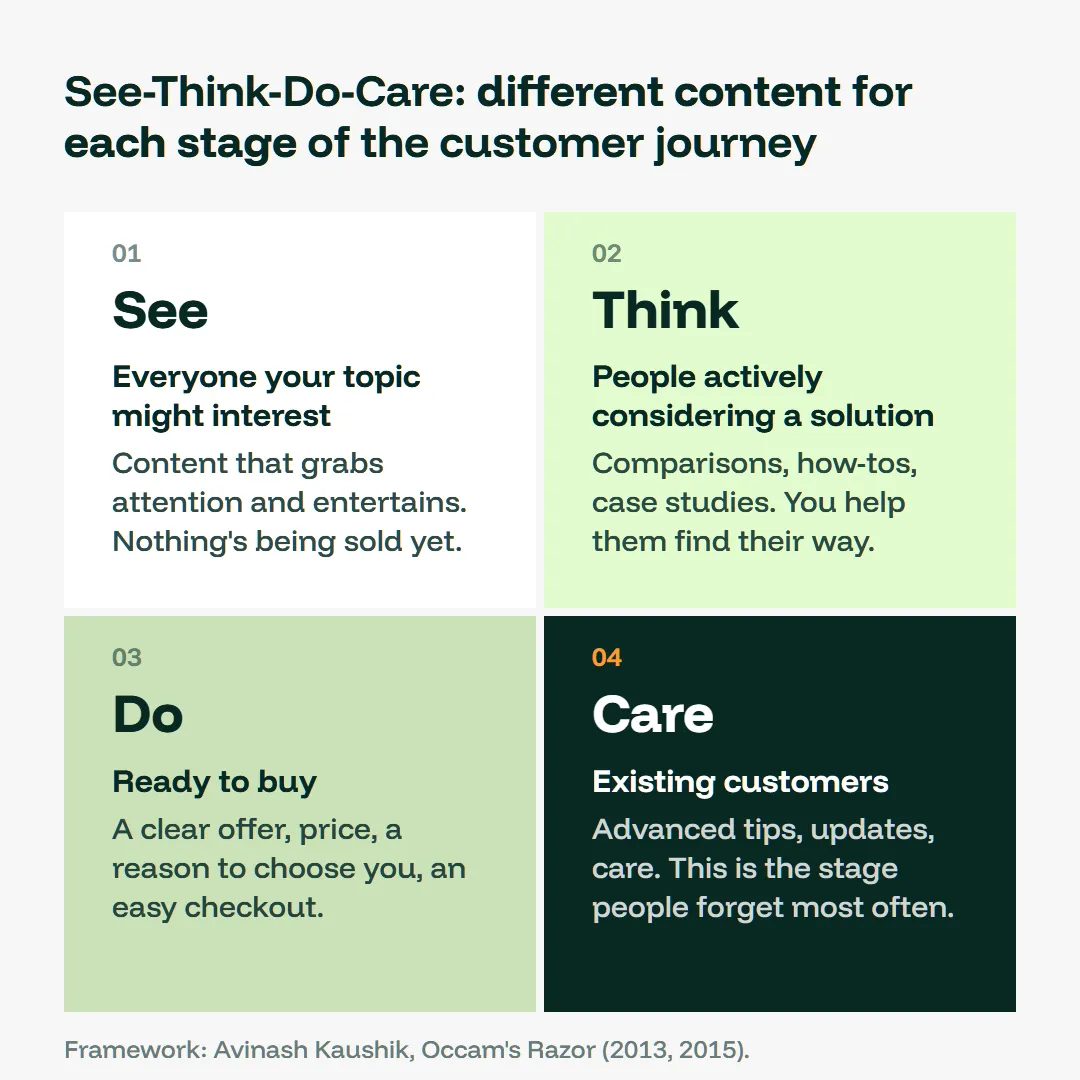
For each stage, define the specific content and channels you'll use. That way you won't waste resources on activities that don't fit, and you won't lose potential customers somewhere along their journey. I explain how to decide what to write about and what to leave out in my article on how to build a content strategy.
Step 5: Measure and adjust
A strategy isn't set in stone – it's a living document that evolves. Start by setting 3–5 key performance indicators (KPIs) that tie directly to your goals. These could be your conversion rate, the number of qualified leads, customer acquisition cost, or the share of returning customers. Build a simple overview that shows where your metrics stand at a glance.
Schedule regular reviews, ideally once a month. At each one, pick one thing you can improve, make the change, and measure its impact. That way you improve step by step, without radical changes that could disrupt processes that already work.
Also accept that not everything can be measured. Brand and SEO have an effect even where analytics can't see. Decide up front what you'll measure and what you'll simply trust – and don't expect a dashboard to answer everything.
Keep in mind that small adjustments every month beat one big change a year. Gradual data-driven improvement works better than a complete overhaul of the strategy, which often leads to chaos and a loss of continuity.
Where to start when you don't have time for everything
Customer and differentiation first. Without a clear picture of who you sell to and what your competitive advantage is, the other steps have nothing to stand on.
Ask yourself: Who exactly is our customer? Why should they buy from us and not someone else? What do we offer that our competitors don't? Where are we genuinely better? Why do customers come back to us?
Once the basics are clear, move on to the other elements that form the backbone of a strategy document:
Some parts of a strategy, on the other hand, can wait until the basics are firmly in place: a detailed analysis of every competitor, a detailed content strategy, plans for new channels, or detailed personas and customer journey maps.
Follow the idea behind the 80/20 rule – first the few things that carry the most weight, the rest later. Take the ratio figuratively, not as a measured fact. You'll see your first results sooner, and the sheer number of tasks won't overwhelm you at the start.
Your first step in 30 minutes
If you want to start right away, here's a first step you can take in the next 30 minutes. Sit down with a sheet of paper (or open a new document) and answer these 4 questions:
- What is our main goal for the next 6 months?
- Who is our ideal customer, and what problem do we help them solve?
- How are we different from our competitors?
- What 3 key things do we need to communicate for a customer to choose us?
A simple document like this gives you a foundation for your strategy. Ideally, go through it with your team and make sure everyone understands the direction the same way. Even though it's only a start, it will give you more direction and consistency than most tactical activities without a strategy.
The most common obstacles and how to get past them
When creating and rolling out a strategy, I often run into obstacles that can slow the whole process down or stop it altogether. These are the 3 I hear from clients most often.
No time for strategy
“We don't have time for strategy, we've got day-to-day work to deal with.” I hear this from clients all the time.
What can you do about it? Start with small blocks. Set aside 2 hours a week just for strategic thinking. You don't have to create the whole strategy at once – split it into parts and work on them one at a time. The time you give it comes back to you in your day-to-day work, because you stop doing things that lead nowhere.
Leadership wants results now
Management often expects immediate results, which can lead to favoring short-term tactics over strategy.
How do you handle it? Set expectations clearly from the very start. Identify quick wins you can deliver in the first few weeks while you build the long-term strategy. That buys you time and trust for systematic work. The key is to show progress regularly, even when it's only preparatory steps so far.
You don't have answers to some questions
A common obstacle is when I ask a client about things they don't know themselves, or never thought to consider.
When defining the target audience, for example, market and customer research can help – we combine what the client knows from experience with data from analytics, the CRM, surveys, and interviews. In a SWOT analysis, looking at competitors helps us get clear on what's standard and what's extra, or where we're below average or don't offer a service everyone else does.
The key is a systematic approach and a willingness to admit that we simply don't have some answers yet – that's better than building on assumptions.
When to bring in someone from outside
You can create a strategy yourself if you have the time and the nerve to be honest with yourselves. Outside help pays off mainly in 2 situations: when people in the company can't agree on who the customer is, and when you're looking for what sets you apart – that's hardest to see from the inside, because everything you do seems normal to you.
When I build a strategy with a client, we start by clarifying what they have in mind and showing what a strategy usually covers. Then we agree on the brief and the format of the output. The whole process is a mix of consultations, filling in each other's gaps, and approvals – there's no point in me putting a strategy together without the client when I don't know the details of their business. The result is a document you can actually work from, not a theoretical one that gathers dust. If you're curious what happens from the first meeting on, see how working together goes.
A basic strategy you actually use wins
The best strategy is the one you actually start using. That's why it's better to have a basic but working strategy you can put in place right away than a perfect document that gathers dust. Start today, even if it's just with that 30-minute step, and develop your strategy over time based on experience and data.
FAQ
What is a marketing strategy?
A marketing strategy is a decision about who you sell to, how you differ from your competitors, and what goal you want to reach. Channels, campaigns, and content only follow from it. This article is mainly about the process – for what a strategy includes and what it doesn't, see my page on marketing strategy.
What's the difference between a marketing strategy and a marketing plan?
A strategy says where you're going and why: for whom, with what differentiation, and toward what goal. A plan works out from it what you'll actually do – channels, deadlines, budget, and who's responsible for what. A plan without a strategy is just a list of activities, which is why it makes sense to write it only after the strategy.
Is there a marketing strategy template?
You'll find plenty of templates online, but a filled-in template isn't a strategy yet – the difference is in the answers, and nobody can fill those in for you. Feel free to use the 6-point list from the section “Where to start when you don't have time for everything” and the positioning formula from step 3 as a skeleton. But fill it in only after you've talked to customers, or you'll just carry your assumptions over into it.
How long does it take to create a marketing strategy?
There's no fixed timeframe – it depends on the size of the company and how much you already know about your customers. The preparation usually takes more time than the document itself: interviews, looking at competitors, and tracking down data. But you can start putting together the core of your strategy right away and build on it in your regular reviews.
Share the article